Repairs · Woodbridge
Garage Door Tune-Up in Woodbridge
Since the first cold snap the door has been sluggish. It climbs slowly, hesitates near the top and the opener motor sounds strained.
Garage Door Tune-Up
In plain words
A tune-up is also a safety check of the opener. Openers made since the early 1990s carry two ways of protecting anything in the door's path: photo-eyes near the floor that reverse the door when the beam is broken, and a contact reversal that sends the door back up if it meets resistance. The technician cleans and aligns the sensors, then tests both: an object waved through the beam while the door closes, and a 2x4 laid flat under the centre of the door. A door that reverses cleanly on both is doing what its maker intended, and you learn how to repeat the test yourself each month.
How the visit goesSince the first cold snap the door has been sluggish. It climbs slowly, hesitates near the top and the opener motor sounds strained. On the coldest mornings it opens a hand's width, thinks about it, and comes back down.
Woodbridge
How the visit goes
Watching one full cycle first
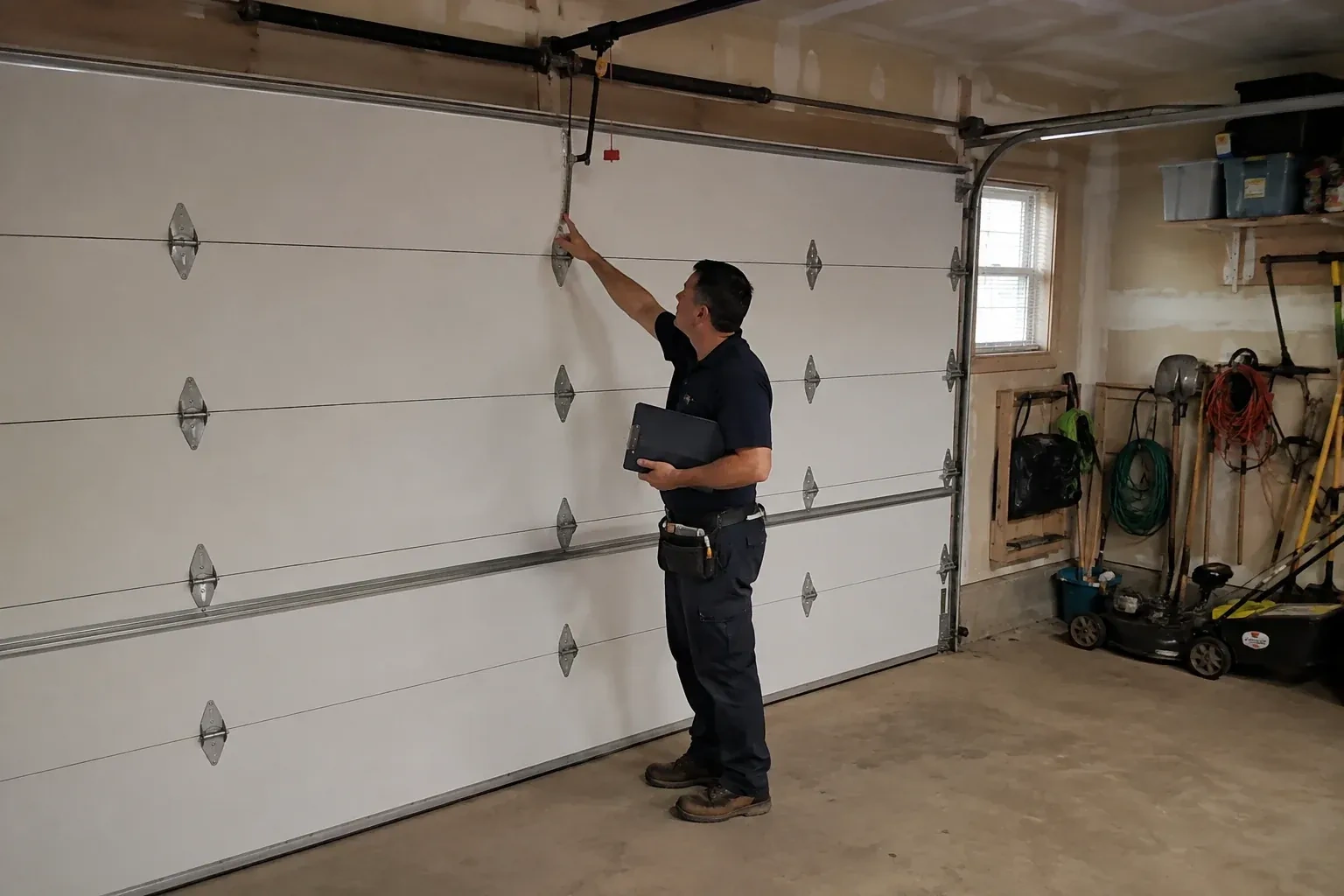
Before a wrench comes out, the technician stands clear of the opening and runs the door all the way up and all the way down. They are listening and watching at the same time: where the squeal starts, whether the sections shake at a particular height, whether the door hesitates at the curve of the track, how it lands on the floor, and whether the opener labours or hums. Each observation is tied to a spot on the door or a point in the travel. That map guides the hands-on inspection that follows and gives a fair comparison at the end, when the same cycle is run again after the work.
Chain, belt, rail and trolley
On a chain-drive opener the technician sets the chain so it neither sags onto the rail nor pulls taut, following the maker's measurement at the midpoint, and lubricates the chain and rail only where that maker calls for it. A belt drive is checked for tension, cracking and fraying. The trolley is inspected for wear where it rides the rail, the release lever is worked to confirm it disengages and re-engages cleanly, and the door arm is checked for straightness and secure pins at both ends. Rail hangers are tightened so the whole assembly stops shaking when the door starts and stops. This quiets the ceiling and takes strain off the motor's drive gear.
Balance you can feel with one hand
Before leaving, the technician shows you how to check the balance yourself: pull the red release with the door closed, lift the door by its handle, and feel it rise easily, stay open and hold still partway. Knowing what a balanced door feels like is the single most useful thing a homeowner can take from a tune-up, because a door that starts to sink or grow heavy over the coming year is telling you the springs are tiring, long before the opener fails. If the balance was found wanting on this visit, the operator is taken out of service until the spring work is done, and that finding is in your record with a separate quote.
Garage Door Tune-Up
In the van
- 2x4 test block and tape measure
- Photo-eye brackets and wire
- Bottom seal (astragal)
- Jamb and header weatherstrip
- Locking pliers or C-clamps
What affects the quote
Same fees day, night or weekend
1Single or double door
A double-width door has more hinges, rollers and track to inspect and lubricate, a heavier counterbalance and usually a strut or two on the top section, so it takes longer than a single door.
2Type of opener
Chain, belt, screw and wall-mounted jackshaft openers each have their own tension checks and lubrication points, and older units take longer to set for travel and force than newer ones.
3Torsion or extension springs
Torsion springs above the header and extension springs beside the tracks are inspected differently, and extension systems have pulleys and safety cables that add items to the checklist.
Garage Door Tune-Up: questions
The sensor light is blinking. What does that mean?
On most openers a steady light on each photo-eye means the pair are aligned and seeing each other, and a blinking light means the beam is interrupted or the sensors are out of line. Common causes are a bracket nudged by a bin or a tire, dust or salt film on a lens, low sun at a certain hour, or a chafed wire. During a tune-up the lenses are cleaned, the brackets straightened, the pair realigned and the wiring checked back to the opener.
How long does a tune-up take?
For a single or double residential door with an opener, allow roughly an hour to two hours on site. The inspection and the two observed cycles take a fixed amount of time; the rest depends on how many fasteners have loosened, whether the sensors need realigning and whether you approve a small part replacement, such as a worn roller, during the same visit. Spring or cable work, if found necessary, is scheduled as its own job.
What is the difference between a tune-up and a safety inspection?
An inspection looks and reports; a tune-up looks, reports and then does the maintenance. Both begin with an observed cycle and a check of hardware, balance, sensors and reversal. A tune-up goes on to tighten fasteners, lubricate the moving points, adjust the opener and align the photo-eyes, and it may swap a worn roller or a bottom seal on the spot. If you want the door serviced rather than assessed, the tune-up is the one to book.
Repair & Maintenance
- Off-Track Garage Door ResetOne side of the door hangs a hand's width lower than the other.
- Garage Door Panel ReplacementThe top section has developed a bend where the opener arm pulls on it.
- Garage Door Bottom Seal ReplacementThe strip under the door has gone as hard as a hose left out for ten summers.
Garage Door Tune-Up near you
In Woodbridge we work on garage doors of every age and size: single and double residential doors, insulated and uninsulated, wood and steel, plus commercial rolling and sectional doors. The service pages explain the repairs, replacements and installations that apply to each.