Openers · Kleinburg
Chain-Drive Opener Repair in Kleinburg
Halfway up, the door lurches. Something in the drive skips a beat, the chain jumps, and the door finishes its travel with a jolt.
Chain-Drive Opener Repair
In plain words
Sometimes nothing is broken and the operator has simply forgotten where the door should stop. Travel limits tell it how far to run in each direction; force settings tell it how much effort is normal, so it can notice an obstruction. When limits drift, a door stops short of the floor, reverses at the bottom or opens partway. When force is set low, the door reverses for no reason; set high, it stops protecting anyone beneath it. A chain-drive repair resets both, by screw on older heads or learn buttons on newer ones, then proves the reversal with a block on the floor.
How the visit goesThe door closes, touches the floor, then climbs straight back up as if it hit something. Nothing is in the way, the sensor lights are steady, and it has been doing this since the weather turned.
Kleinburg
How the visit goes
Where the door stops and how hard it pushes
Two settings on the head decide the door's behaviour, and both are checked against what the door is doing. Travel limits set where the door stops in each direction; a door that stops shy of the floor, reverses on touching it or opens partway is out of adjustment. Force sets how much effort the operator treats as normal; too little and the door reverses for no reason, too much and the operator stops noticing an obstruction. The technician notes the current screw positions or the learned values, watches a full cycle and compares what the door does with what the settings say, before deciding whether the fault is in the drive parts or only in the settings.
Fitting a new chain
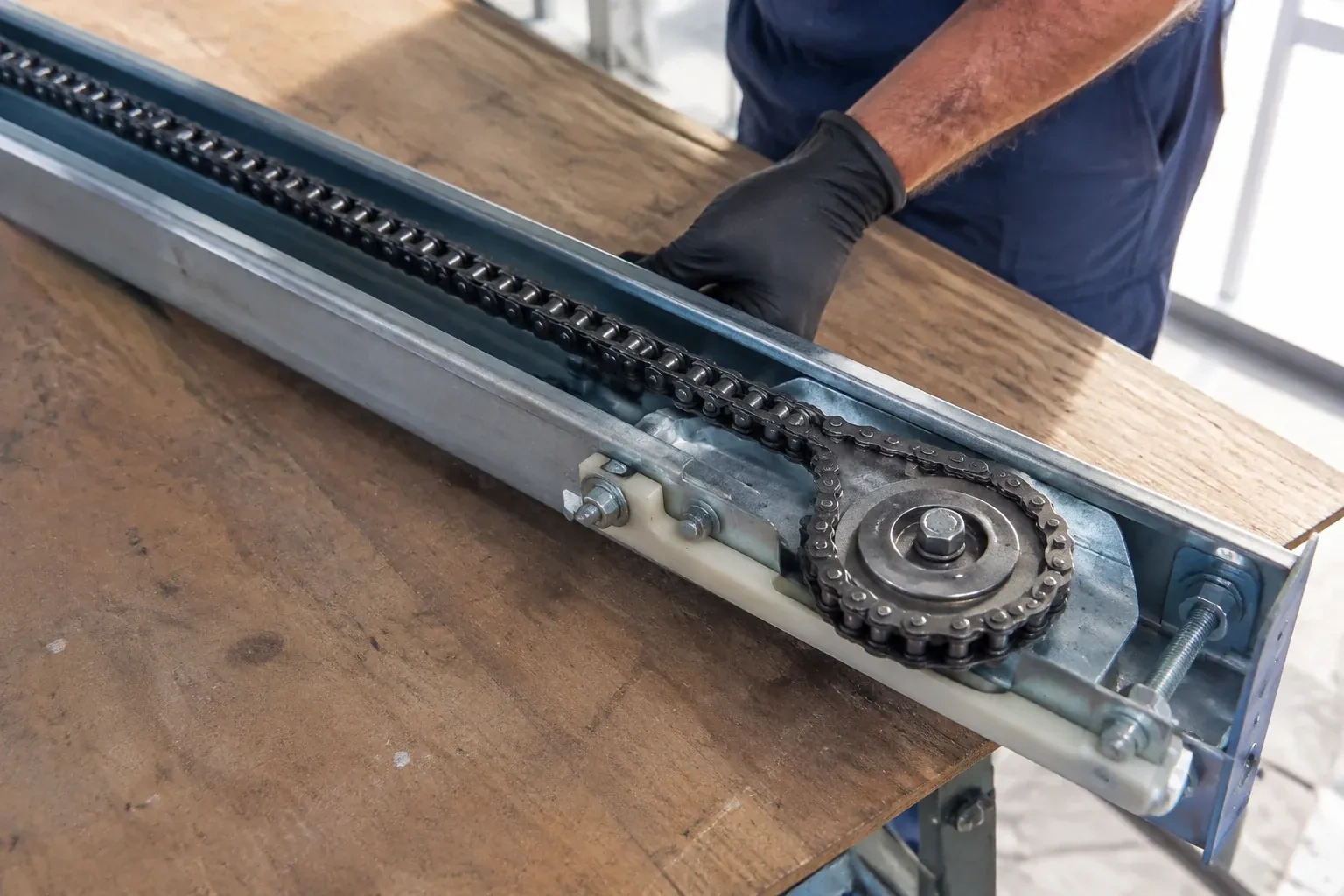
A stretched or rust-bound chain is replaced as a unit. The technician disconnects the door, slackens the tensioner and opens the master link, then draws the old chain off the sprocket, through the trolley and around the idler at the door end. The new chain, sized to the rail length, is threaded the same way, joined at the master link with the clip facing away from the direction of travel, and settled onto the sprocket teeth by hand. Any cable section on a combined chain-and-cable drive is checked for fraying and renewed if needed. The chain is then tensioned to the rail's specification and the trolley run by hand along its full length.
Getting the chain drive through the cold
In a detached or unheated garage the drive has been set up for winter: force adjusted so the door moves at low temperature without the operator being oversensitive, the rail greased, and the door hardware lubricated before frost. Two habits help. Keep the threshold clear of snow and slush so the bottom seal does not freeze to the slab, and if the door reverses on a bitter morning, free the seal rather than pressing the button repeatedly; the operator is doing what it should. Expect the chain to sound a touch different at minus twenty, and let the garage warm before deciding something is wrong.
Chain-Drive Opener Repair
In the van
- Cold-rated garage door lubricant
- Trolley release lever
- Rail hangers and header bracket
- Idler sprocket or pulley
- Roller chain with master link
What affects the quote
Same fees day, night or weekend
1Door hardware quieted at the same time
Nylon rollers, new hinges or a vibration isolator chosen to quiet the door and the ceiling alongside the drive repair are optional items listed on their own.
2Adjustment only, or parts as well
A visit that ends with tension, phase, limits and force set and the reversal tested is the simplest case. Each part fitted on top of that appears as its own line.
3The gear kit for your model
Drive gear, worm gear and sprocket shaft assemblies are made to fit a particular head, and the kit for an older or less common unit is a different item from the one for a current model.
Chain-Drive Opener Repair: questions
Should I use the slide lock on the door with a chain drive?
No. The manual slide lock on the door is disabled or removed once an operator is connected, and the technician checks that during the repair. A motor pulling against a locked door strains the chain, strips the drive gear and can bend the top section of the door. If you want the door secured against remotes, the lock button on the wall control switches them off, and a track lock designed to work with an operator does the rest.
The door is stuck. Should I pull the red cord?
Yes, if you need the door open and the door is closed or nearly so. Pulling the handle frees the door from the trolley so it can be lifted by hand. Do not pull it while the door is open, because a door with a weak spring can drop. If the door will not lift by hand, or feels very heavy, leave it and mention that when you call, since it points to a spring rather than the drive.
What does it mean when the drive is out of phase?
The motor keeps track of the door's position by counting its own turns, and the trolley is meant to be at the closed end of the rail when the motor is at its closed position. If the operator has been run with the chain off the sprocket, or a chain was refitted at random, the two no longer agree and the door travels partway however the limits are set. Re-phasing means finding the motor's closed position and refitting the chain with the trolley closed.
Openers & Access
- Belt-Drive Opener RepairThe belt looks fine from a distance, but up close the rubber has cracked across the back in dozens…
- Garage Door Opener ReplacementDuring the ice storm the power was off for two days.
- Photo-Eye Sensor Alignment or ReplacementAfter a cold night the door stays open until the garage warms up.
Chain-Drive Opener Repair near you
Most calls from Kleinburg start with a symptom rather than a part name: a bang, a door stuck halfway, a remote that only works from the driveway. Below are the services behind those symptoms, from spring and cable replacement to opener repair, panel work and complete door installation.